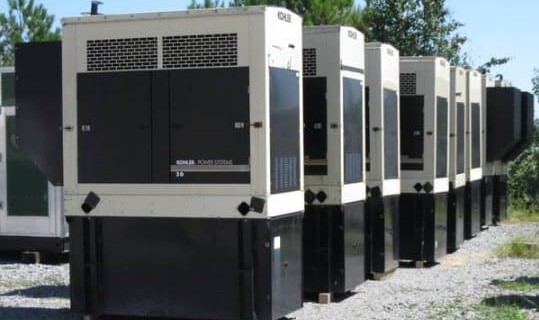

What is Load Sharing in Diesel Generators?
Load sharing is the process of distributing electrical load evenly (or according to a set priority) among multiple generators running in parallel. This is essential in applications where the power demand exceeds the capacity of a single generator or where redundancy and flexibility are required (e.g., in hospitals, data centers, industrial plants).
Types of Load Sharing
- Real Power (kW) Sharing – Managed through speed control.
- Reactive Power (kVAR) Sharing – Managed through voltage control.
How Load Sharing is Accomplished
- Governors (Speed Controllers) – Adjust the engine’s fuel to control real power output.
- AVRs (Automatic Voltage Regulators) – Adjust excitation to control reactive power output.
- Parallel Operation Controllers – Like ComAp IntelliGen or DSE8610, these facilitate synchronization, load sharing, protection, and communication.
Real Power Load Sharing (kW)
- Managed by adjusting the engine speed.
- Generators with matching droop and setpoints will share active power proportionally.
- If one generator is overloaded, load-sharing control reduces its fuel injection (and therefore power output), while increasing it for the underloaded unit.
Reactive Power Load Sharing (kVAR)
- Managed by adjusting excitation voltage.
- Each generator's AVR needs to coordinate with others through either:
- Cross-current compensation or
- Centralized controller logic.
- Imbalance can cause circulating currents, overheating alternators.
What is Speed Droop?
Speed droop is a method of governing in which the generator’s output frequency slightly decreases as load increases.
Example:
- A generator set to 50 Hz at no load may drop to 49.5 Hz at full load (1% droop).
- This natural drop allows multiple gensets to share load without fighting each other.
Relationship Between Power Management and Speed Droop
Power Management Goals:
- Maintain stable power supply.
- Optimize fuel usage and efficiency.
- Avoid overloading or underutilizing any genset.
Speed Droop’s Role in Power Management:
- Acts as a self-regulating mechanism for load sharing in real power.
- Prevents hunting and instability during parallel operation.
- Works with the power management system (PMS), which:
- Starts/stops gensets based on demand.
- Balances load across generators.
- Prioritizes certain sets (e.g., base load, peaking).
Without Droop:
- All generators would try to maintain identical speed.
- Even slight load changes could cause unstable oscillations (known as “hunting”).
Summary
| Aspect | Description |
|---|---|
| Load Sharing | Ensures even distribution of kW and kVAR among generators. |
| Speed Droop | Allows generators to share load proportionally without control conflict. |
| Power Management | Oversees operation strategy — including which gensets run, for how long, and at what load. |
| Interconnection | Droop is foundational for real power sharing, which is one of the core tasks of power management systems. |
If you're using advanced digital controllers like ComAp IntelliGen, DSE8610, or Woodward, these functions are built-in and managed automatically through CAN communication or analog signals, reducing manual tuning and increasing system resilience.